Showing posts with label Demo (Encouraging Gesture). Show all posts

Painting Demo: Stage 12 (Part 2)

...And now for Part Dos. Today I'll talk about the alterations I made to Sydney and the background.

Background

Again, here are the "before" and "after" shots of the painting:

Before
After

The most obvious changes to the background are the deletion of the far desk (for simplicity) and the addition of the baseboard (to give my setting greater believability). I also darkened along the lower left side per my original value study in Stage 3.

Squint down at the "before" image above (squinting helps to accurately compare shades of dark and light, which are called "values"). Do you see how the lightest value of the blue wall is nearly as light as Sydney's face? Although I wanted Sydney's face to be darker than Jackson's, I also wanted her face to be lighter than anything else in the background, so I darkened the lighter parts of the wall.


Before
After
I further corrected the angles of the bookshelves and added books to the bottom shelf. Also, I established more depth between Jackson's head and the bookshelf behind it. I did this by softening some edges and simplifying some shapes in the area behind Jackson's head to make that area recede and darkening Jackson's hair a bit to bring his head forward.


Sydney

What did I change on Sydney? Well, it would be easier to tell you what I didn't alter. Her hands, basket and apples were the only parts that escaped getting reworked!

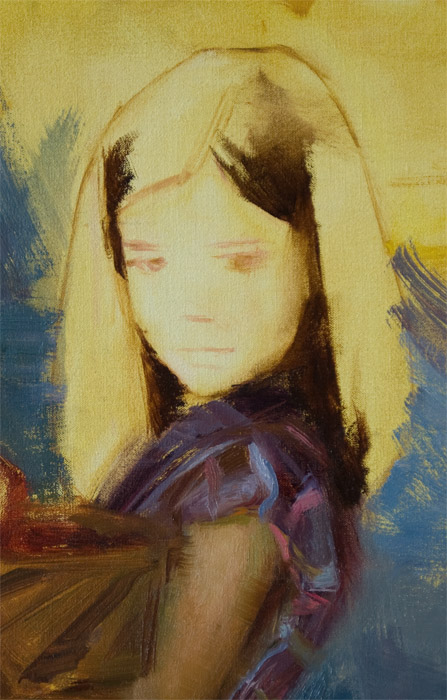
Before

After
This time around, I took my time on Sydney's head to establish a more accurate drawing, softer edges and livelier color. Also, I think I was better able to capture the spark of kindness in her expression that I needed to tell my story.

Before

After
I had left Sydney's dress quite unfinished. As I reworked it, one of my goals was to use the dress as a device to attract the viewer's eyes up towards Sydney's face. To do this, I darkened the lower part of the dress to make it look like Sydney's torso and head were emerging into the light (the eye is usually more attracted to areas receiving light). This was a challenge. Not only did I have to gradually lighten and cool each color of the plaid pattern as it emerged into the light, but also I had to make each value and temperature correctly relate to each other within each region of the gradation. Furthermore, I had to paint with the flair of Sargent or else face certain arrest by the Art Police. Talk about pressure! Just kidding on that last part. I evaded capture in spite of failing at Sargent-flair. And just for the record, the concept of "Art Police" is original to Mr. Schmid. I approached the challenge of the dress the same way I did Jackson's face (for details, check Stage 12, Part 1). First, I mixed large piles of paint that matched each color of the plaid pattern in the light. Then I mixed about 3 more versions of each of these colors, each one progressively darker and warmer. I laid out all these color piles in an organized fashion on my palette. Then, with all of my main colors pre-mixed, I could focus on flailing away with some looser brushwork! I have heard that Whistler would also mix an array of colors in large piles beforehand, so it must be OK!

When I painted the initial block-in of Sydney's dress, I messed up the edges of the chair spokes. Comparing the before and after shots above, you'll notice these have been fixed.

Before
After
I sculpted the anatomy of the arm more fully and carefully than before. It's always a challenge to not oversimplify subtle anatomical forms, but especially so on children, whose anatomy is softened. On the flip-side, overstating anatomy can also be dangerous.

Detail

Final words

Whew! That was a lot of repainting, wasn't it? So how do I know when an area of a painting is "finished"? When I don't know what else I can do to make it better (to paraphrase modern master Morgan Weistling), and when I'm satisfied that I've done my best.

Thank you again for joining me on this venture! I praise the Lord for His great help with this painting. Have a great day, everyone!

Until next time,
Adam Clague

Painting Demo: Stage 12 (Part 1)

Encouraging Gesture
Oil • 22" x 30"
Hi everyone! Remember that painting demonstration I began two eons ago and never completed? Well, I've finally finished it! Yes, folks, your eyes do not deceive you... it's Stage 12!

Please accept my humble apologies for taking much longer to finish than the 1-to-2-week estimate I gave in Stage 11. I was tempted to deem the picture "finished" a while ago, but I'm glad I kept working on it, because now the painting is much closer to my original vision. The completed painting, which I've titled "Encouraging Gesture," is to the right.

As I promised in Stage 11, this post has lots of pictures showing "before and after" versions of each area I've reworked since last time (which, ironically, is just about every area!). You see, I strove to keep this demo concise by covering as much canvas as I could in each stage. As a result, I left many areas unfinished. Since last time, however, I've touched-up, reworked and, in some cases, completely repainted these unfinished parts. My alterations are shown below with text explaining my decisions. Let me say, this post is bigger than a hippo on Twinkies. It's so large, in fact, that I decided to break it up into two parts. I'll post the second part tomorrow. Remember, you can click any image to view it in high-resolution. Enjoy!
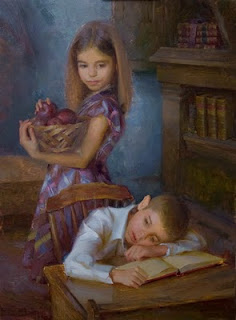
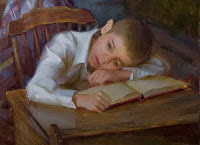
Before
After


Jackson and Desktop


Before
After

Although it may not be evident at first glance, the above "Before" and "After" stages represent a lot of rework. Jackson is my painting's main "focal point" or "center of interest." This means he is the most important element in the picture. I chose to do this way back in Stage 1. Now, don't get me wrong, Sydney is equally important to my story. But if two elements in a picture are allowed to compete for attention, the painting is usually weakened (No offense, Sydney! I'll make you most important in another painting if you're willing to pose for me again!). I made Jackson the center of interest by reserving the lightest values of the piece for his skin and shirt. This draws the viewer's eyes to him and makes him "pop" forward. The very lightest value of all was reserved for the highlight of the collar. This helped to direct attention to Jackson's face. To make the collar highlight bright enough, I actually darkened parts of the sleeve. If you squint at the two images above, you'll see the difference. I had to bring the sleeve to a more finished state anyway, so I just darkened it a bit while I was at it.
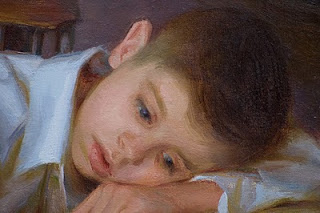

Well, I almost completely repainted the little guy's noggin. Jackson's head was very challenging for me because the value and temperature shifts within the light side were extremely subtle. It was also difficult because I wanted to deviate from my reference photo by making the cheek highlight the lightest value of the face. By doing this, I was able to give a slightly stronger sense of spherical form to the head and, therefore, make it more life-like.

As I began the repainting of Jackson's head, I first mixed up five piles of flesh colors, each a different value. Mixing up plenty of paint beforehand always makes things easier. From each color pile, I extended a "trail" of paint. Into these trails, I mixed cooler and warmer variations of the original color. By doing this, I preserved part of the original pile of color for future use. Mixing an array of colors ahead of time allows the artist to compare each hue next to each other on the palette before placing it on the canvas. A picture of my palette during this stage is above.
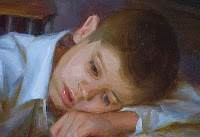
Once I mixed my basic flesh color piles, I blocked-in Jackson's face again. You'll notice in the photo to the left that all my shapes have sharp outer edges. This is because the value and temperature choices were so difficult (for me), that I could not concentrate on correct edge-work simultaneously. After I established an accurate groundwork of values and temperatures, I softened my edges and added a few touches of more vibrant color. Here's a tip: I find that I can achieve a "looser" look if I add a transitional tone to soften an edge instead of simply blending it with a clean brush. Nevertheless, remember that brushwork variety is important.

If you're an aspiring painter who gets discouraged when you find you must repaint an area of a picture, take heart! This is completely normal. Sargent himself was said to have sometimes repainted heads over 15 times before he got them right (illustrator James Gurney has a great post about this at his blog here). If Sargent was not exempt from painting struggles, we have no reason to be discouraged when we have difficulties. I hope that's as much of an encouragement to you as it is to me!

I bet you were wondering when on earth I would finish that lower hand! Until this stage, I had left it in a state of block-in limbo.

The book's pages got a makeover, namely with a sharper edge between their top and side planes. This gave the pages a little more solidity. I also tried to improve the overall color and added "words" (Hint: never try to actually paint tiny things like book text and eyelashes. Instead, paint the overall impression of what you see). Finally, I cast a subtle shadow over the right-most corner of the book to prevent it from directing the viewer's eye out of the canvas like an arrow. Sorry, you'll have to scroll up to the un-cropped image to fully see this change.


I added a notebook and pencil to the desktop for three reasons: 1) I did not want the blue wall in the background to be the only area where that color occurred. 2) I thought the value shape of the desktop was too uniform and needed to be "broken up" by other elements. 3) I wanted to reveal the raised back edge of the desk more clearly.

That's all for now, folks! Tune in tomorrow for images and discussion of my changes to Sydney and the background. Have a great night!

Painting Demo: Stage 11

Well, it's the moment you've all been waiting for... the final stage!!! Well... almost. Here's the deal: In an attempt to keep this demo concise, I have tried in each stage to simply cover as much canvas as possible. As a result, I have left many areas unfinished. If I continue daily posts showing the completion of each of these areas, I'm afraid this demo would become quite tedious. And I don't want to bore anyone! So you, my faithful bloggers, have my word that I, Adam Clague, will post the finished work once it is completed. Don't worry, it should only take another week or two before it's done. At that time, I'll make a final post with lots of detail shots showing each area I have reworked. For those of you who are Facebook friends, watch for my status announcement of the final final stage.

I hope you will forgive me for not having too much new to show you. I was limited to a half-day of painting, since the other half was spent tunneling through white mountains that dropped on us northern states yesterday evening. However, I did manage to paint some more books and resolve some issues with the background.

To everyone, a hearty "thank you!" for following this painting demonstration! I've had a great time, and I praise the Lord for how He has helped me with the painting. I hope you have enjoyed it too. As I mentioned before, be sure to check back in a week or two for the final installment. God bless!

Painting Demo: Stage 10

Making sure my perspective is right!
Welcome back, everyone! Thanks for taking time to stop by. Well, much of today was spent ensuring that my perspective is correct. Any time an artist is painting architecture or geometric objects, he must make sure that his perspective is accurate. Otherwise, his painting can have disproportionate scale or a feeling of unbalance. Unfortunately, I don't have time to write a detailed discussion on perspective, but I will give some basics. The artist must determine where his picture's horizon line is. The horizon line will always be at the level of the viewer's eyes. Mine is marked in the photo with a green line. The artist must remember that all horizontally level lines that are parallel to each other will appear to converge at the same point on the horizon line. This point is called the "vanishing point." The gray lines in the photo represent the edges of the desk and bookshelf, which all need to meet at the same vanishing point. I still have a few bugs to work out with my perspective, but it's getting there!


Top of bookshelf turning corner
Originally, I wanted the top of my bookshelf to turn a corner. I was hoping this would create a line that would lead the viewer's eye to the girl's head. Unfortunately, after I painted it this way, I decided it wouldn't work. Both angles of the corner turned out to be nearly horizontal, which looked confusing.


Top of bookshelf modified
So... I opted to keep the top of my bookshelf straight. I'll have to do some planning to figure out what I'm going to place behind the girl's head now. Maybe I'll just put more of the wall back there; we'll have to see! By the way, in case you're wondering, I'm painting the bookshelf and books from life. The bookshelf is actually a faux fireplace mantle my parents were storing in their attic. And since I'm on the topic, I also painted the apples from life yesterday, although I failed to mention it.


Full canvas at Stage 10
Here's the full image of my painting so far. I hope all of you are having as much fun as I am! Happy painting, everyone, and have a fabulous weekend. I hope to see you back on Monday the 21st for more brush-wielding!

Painting Demo: Stage 9

Wow, nine stages! I bet you thought I'd be done by now, didn't you? Thank you for your patience! Believe it or not, this painting has actually gone quite quickly and smoothly for me. I'm thankful for that! I am also grateful for all the kind comments people have made here and on Facebook, and for the new friends that have decided to follow this blog. Thank you!

Today I had some responsibilities besides painting, but was still able to finish Sydney's other hand as well as the apples. Tomorrow I'm planning to tackle the large unfinished area in the upper right (check Stage 8 to see a full shot of my painting). I'll need to rig up a still-life of sorts that will mimic the bookshelf I have planned for that area (See Stage 3).

I'm sorry this post is so short. Hopefully that novel I wrote last night can count for tonight too! Anyways, there is a very special young lady I want to call, so I must cut this short. See you back here tomorrow, Friday the 18th--same Bat-time, same Bat-channel!

Painting Demo: Stage 8

What a wonderful day of painting I had! Why was it so wonderful, you ask? Because I had fun! I don't really have too much to talk about though. Today I decided to park and work on Sydney's hand, arm and basket. The arm still needs a bit of work, but the hand and basket are finished (For now).

Brushwork

Since this image is basically a detail shot, I think I'll talk a bit about brushwork. Brushwork is important. And not. If the fundamentals of representational (realistic) art are listed in order of importance, brushwork comes in dead last: 1) Drawing, 2) Values, 3) Edges, 4) Temperature, 5) Color, 6) Brushwork. Yet, strong brushwork can sometimes make the difference between a mere technically-accurate rendering and a work of Art.

One key to having strong brushwork is variety: use brush strokes that are thick or thin, opaque or transparent, textured or smooth. Also, vary the direction of your strokes. Stroke both with and against forms. Make each square inch of your canvas alive with variety, so that it could stand alone as a beautiful abstraction. NEVER try to make your brushwork look like another artist's. You'll only frustrate yourself. Strive simply for accuracy and looseness, and above all... be yourself!

That being said... I wanted to be like some of my favorite artists who use Rosemary & Co. Series 278 and 279 long mongoose brushes, so I bought some for myself! They are wonderful, and I recommend them to any artist. They have a great "spring," allow a lot of reworking and have hairs that can be either splayed or shaped to a razor's edge. They are very similar to Royal Langnickel long mongoose brushes.

Want to paint more loosely? So did I, so I developed some "rules" that I disciplined myself to follow:
•Mix up plenty of paint. Nothing flattens a painting more than trying to spread too little paint.
•Never sit down.
•Back up after every stroke. And I mean back up at least eight feet. If a passage looks accurate from eight feet away, it's good--don't mess with it anymore! You should be constantly pacing back and forth
•If you are working from photos, angle your photos (or computer monitor) so that you have to back up at least eight feet to see both your source images and your canvas straight on.
•Hold your brush handle halfway back and use your whole arm when making strokes.

Keep following these rules until you see a change in your work. Then you can try sitting down or painting more strokes between each time you back up. If your painting tightens up again, go back to following the rules more strictly for a while. By the way, there's nothing wrong with painting tightly. Brushwork should be left to the preference of the artist (fundamentals 1 through 4, however, CANNOT be left up to preference).

Thanks again, everyone! Meet me back here tomorrow, Thursday the 17th for the next installment!

Painting Demo: Stage 7

I hope everyone had a marvelous Valentine's Day! For those of you that checked the blog for new material yesterday, I apologize. I took the day off to spend time with my wonderful girlfriend Andrea Orr. Today, I'd like to show the progress I've made on Sydney's head.

I started by massing-in the darkest values. When starting a new area of a painting, it's a good idea to establish your darkest values first (or the lightest ones). That way, you have a standard against which to gauge all the other values. You can then ask yourself, "how much lighter is this new value than my darkest value?" and so-on.

At this stage, you'll notice a lot of my strokes have sharp edges. These will get softened later. At this point, my priority is to establish a strong value pattern (arrangement of darks and lights). When painting a head, I remember the "egg principle": Just like an egg, one plane of the human head will be lighter than all the other planes. The lightest plane on any object will be the plane angled closest to a 90-degree angle to the light source. Usually, the lightest plane of the human head is the forehead. However, because of how Sydney is positioned in front of the window, the lightest values happen to occur on her cheeks. I like it, so I'm going to go for it!


And here's what I have so far. Not a finished head, but it's getting there! In the coming days I'll be working on the drawing of her mouth (I want to make her smiling a bit more) and on freshening up my brushwork. This may not happen tomorrow, in case you're wondering. We'll just have to see which area of the canvas I feel like painting in the morning!

Thanks for joining me again! I hope to see you back tomorrow, Wednesday the 16th for more!

Painting Demo: Stage 6

Happy Friday everyone! To jumpstart your glorious weekend, how 'bout a painting demo? Yeah, I thought it was a good idea. Fasten your safety belts, everyone. It's... Stage 6!

As you can see, I am covering my canvas in a systematic fashion, working from the boy outward. Many times, I have a more "A.D.D." approach, jumping from spot to spot until the painting is completed (Let's see... what were we talking about? Oh yeah, painting!). I am trying to emulate the wooden textures of the chair and desk by applying my paint more roughly. Also, I can scrape off paint with my palette knife to suggest that the wood is worn.


Next, I started blocking-in Sydney's skirt. I am trying to make it darker at the bottom and lighter at the top to suggest light falloff. It can be difficult to paint patterned fabrics because they tend to dominate. It is the artist's challenge to keep the pattern "quiet" while still maintaining accuracy. The picture of the skirt below is in progress.


I'm having lots of fun with those violet hues under the cool light! The arm and upper part of the dress are nearly finished here. The hand and basket are still in the block-in stage.


Looking at the full canvas, you'll notice I made Sydney's flesh tones darker than Jackson's. I did this to give the illusion that Sydney is set further back from Jackson. Also, by keeping my lightest tones on Jackson and his shirt, I can establish him as my main focal point.


Yes folks, I now have a headless girl on my canvas. Looks like I also made her hand too large. Poor Sydney! Don't worry everyone, I'll have her back to her normal self shortly!

I tried to post a lot this time since I may not be able to post much (or anything) on Monday because of Valentine's Day. Plus, I know none of you love-birds will want to read a boring painting demo on the holiday anyway! So... see you back on Tuesday, the 15th for Stage 7! For those of you single people out there, I may post a small offering on Monday, but no promises!

Painting Demo: Stage 5

I want to say a hearty "thank you" to all of you who have been following this demo thus far! I'm looking forward to seeing how my painting will turn out and I hope you are too!

Painting Progress

After establishing the drawing (Stage 4), I began to fill in my outlines with the correct shapes and colors. Below is the sneak peek image from Stage 1 (Don't worry, I'll show other pictures too). Don't forget, you can click on any image to view it larger.


The hand in the above picture is an example of how I "block-in" or "mass-in" an area before painting it more fully. Notice how the hand is simplified down to just one flat color for each major plane. This helps me establish a strong structural foundation before laying the details on top.

Here is the finished hand with the second hand blocked-in. I also worked on the shirt, desk and book (sorry, the colors in this photo look a bit dingy).


Top hand complete,
bottom hand in progress

And here's a closeup of the hands that shows my brushwork.


So, I admit I'm at a bit of a loss as to what to discuss in this particular post ("Yep, there's the hands all right... sure tried tuh paint 'em real good... hope ya like 'em..."). But one of my most faithful followers suggested that perhaps some of you would be interested in hearing about my current palette.

My Palette


I said my "current" palette because it varies every now and then. Right now, I'm using a full color palette, which I'll outline below. If you are a beginning painter, I suggest using the palette of Anders Zorn, which consisted of ivory black, white, yellow ochre and either vermilion or cadmium red medium/light. It may seem like such a limited palette would be very difficult to use. However, the Zorn palette is best for beginners because it forces the painter to think in terms of temperatures rather than colors. If you are just on the verge of graduating to a full color palette, I suggest you limit yourself to two of each primary (a warm and a cool version of each), an earth tone (like burnt sienna) and white.

Here's what I have on my palette right now. Yes, I use Winsor & Newton's student grade pigments (Winton) for some of my colors. But I still have a lot of the stuff left over from school, and I'm trying to use it up and not be wasteful.

Cadmium yellow pale hue (Winton)
Yellow ochre (Utrecht)
Cadmium orange hue (Winton)
Cadmium red hue (Winton)
Alizarin crimson (Winsor & Newton)
Transparent oxide red (Rembrandt)
Cerulean (Utrecht)
Cobalt blue light (Rembrandt)
Ultramarine blue deep (Rembrandt)
[Yes, three blues. I know, I'm crazy]
Sap green (Rembrandt)
Viridian (Rembrandt)
Titanium white (Utrecht)

For Sydney's purple dress, I might pull out my Old-Holland tube of cobalt violet dark. I rarely use it because it's my most expensive pigment! And I do so love keeping things inexpensive (hence my Winton pigments).

And there ya have it! Oh, and I use Viva brand paper towels.

OK, now I know all of you are just on the edge of your chairs in eagerness to ask questions or comment on this demo, so let me get the ball rolling. Has anyone decided yet what the story is that I'm trying to tell with this picture? If you have time, let me know by commenting at the bottom of this post or on Facebook. Any comments, questions or suggestions are welcome! By the way, I also need a title for this piece. Any ideas?

Thanks everyone, and have a great night! Be sure to return tomorrow, Friday the 11th for Stage 6!

Painting Demo: Stage 4

Drawing

I know you're thinking, "drawing? I thought you said it was all painting from here on out! I want my money back!" I did say I would be painting from here on out, but this is drawing with paint. And this demo is free, by the way. It is a common misconception that "drawing" is a term used only for black-and-white media such as charcoal or graphite. But "drawing" can also be defined as "the accurate placement of shapes," regardless of what medium an artist is using. When I first approach a canvas, I do not simply start flinging paint around. I must first determine precisely where to fling it.

In order to place the correct shapes in the right spots on my canvas, I use a measuring or "sighting" system. I do not use numerical measurements, but rather comparisons. It's kind of like those "connect the dots" exercises from when you were a kid. I imagine my subject covered with dots. Then I compare the distances between those dots. For instance, I might find that the distance between "dot A" and "dot B" fits 2 1/2 times into the distance between "dot C" and "dot D." Then I make sure to establish that same relationship on my canvas. The "ruler" I use to measure is my brush handle. By sliding my thumb up or down my brush handle, I mark off a length that matches the distance between two dots. Then I can compare that distance to the length between two other points. I keep measuring and comparing until I find where all those points go on my canvas. Then it's as simple as "connect the dots"!


Drawing Stage
(Sydney drawn too large)
Still confused? Don't worry, the above was my attempt to cram a whole week of college drawing instruction into one paragraph. Besides, I get mixed up too sometimes. Take the image to the right, for example. I drew Sydney too large and realized I would not have room on the canvas for her hands and basket of apples. I had to wipe it off and draw her again. But hey, that's life!

Here's the corrected version:
Drawing Stage


I wanted to show two approaches to drawing. You'll notice my drawing of Sydney is much simpler than the one of Jackson. An artist's drawing can be as simple or as detailed as he wishes, as long as he is able to establish an accurate foundation upon which to lay his final paint (to paraphrase the words of my painting instructor Mr. Jekel).

Drawing: Simple approach
Drawing: More detailed approach


Well, I kept this stage shorter for those of you that may have been overwhelmed by yesterday's epic post. Tune in tomorrow, Thursday the 10th, for more fun with Adam!

Painting Demo: Stage 3

Before I get started today, I must address a subject that a follower wished I had discussed in Stage 2--the lighting. I had been to Sydney and Jackson's house several times before I realized, with much excitement, that the huge window in their living room was north-facing! Why, might you ask, was I excited about this? Because for many artists including myself, north light is the preferred light source. This is for a couple reasons:

1) Windows facing other directions will allow direct sunlight to come through at various times of the day. There is nothing wrong with painting a subject under direct sunlight, but it can be difficult, since the artist must work quickly to capture his subject before the sun moves too much or hides behind a cloud. North-facing windows provide consistent light all day long. The brightness of north light may change due to cloud coverings, but the temperature will remain the same (cool light and warm shadows).

2) All types of natural light are beautiful, but north light can be especially picturesque. It provides a natural balance of color that creates gorgeous color harmonies in a subject. Also, it is highly diffused, producing soft, delicate shadows that are especially ideal for portraits (direct sunlight can cast hard, unsightly shadows across a person's face).

It was a blessing that Sydney and Jackson's north window was large enough to cast its light not only on my models, but also on my canvas and palette. OK... now time for Stage 3!

Digital Value Study

Digital Value Study
I know there are some purist painters viewing this demo that are shocked that I would trade the tradition of brush and canvas for digital stylus and tablet. But I view the digital medium as simply another tool in my belt. Never fear, I am an oil painter at heart and probably always will be. Still, I sometimes make a preliminary study on my computer, since it allows me to alter my image more quickly and easily than any other medium. In short, it's a huge time-saver. And before jumping into the painting for this demo, I realized I needed to fully establish my composition's value pattern and eye-flow, since my preliminary sketch left these elements somewhat unresolved (check Stage 1). Comparing this study to my preliminary sketch, you'll notice I "quieted" the bookshelf in the background by darkening and softening it. Now it fulfills its purpose of adding realism to the setting, but without distracting from the figures.

I rendered Sydney's face more completely than the rest of the study to make myself feel better about showing such a rough sketch publicly!


My Composition Analyzed

Because of its somewhat-subjective nature, the concept of composition is a difficult one to discuss. Many compositional decisions are made simply through the intuition of what "feels right." There are, however, some basic "tricks" that can help the artist make the viewer's eye go where he wants it to go. I won't reveal all my secrets right now, only a few that I utilized for this piece.

Figure "A" reveals a large pathway through the piece. It acts as a road, down which the eyes are naturally drawn (as shown by the dotted line). Along the path are my main centers of interest, the two faces.

Figure A

Figure "B" shows some lines that point back to the main pathway, just in case people try to go a-wandrin'. Stay on the path!

Figure B


Figure "C" displays two circuits that are naturally formed by the kids' poses. These act as refreshing oases for the eyes to park at as they make their journey along the main path.

Figure C


Toned canvas (22" x 30")

Tone (A.K.A. "Underpainting")

Well, I promised you I would show you some actual painting on my final canvas, didn't I? I usually start a painting by applying a tone over my canvas. I know what you're wondering--"Why on earth did you paint your entire canvas bright yellow-orange?" Believe it or not, there is a purpose to my choice. I am planning to have an overall blue-violet color harmony in this piece. Blue-violet and yellow-orange are complements (on opposite sides of the color wheel). When an artist juxtaposes two complementary colors side by side, it produces a dazzling effect to the eye that cannot be produced by simply mixing the two colors together. By only partially covering my underpainting when laying down my blue-violet colors, I hope to produce such an effect. We shall see!

OK, that's enough for today. And in case any of you are bored to death of hearing about my preliminary process, don't worry--its all painting from here on out! Be sure to come back tomorrow, Wednesday the 9th, to see the next phase!

Painting Demo: Stage 2

Welcome back! Today I'd like to begin by talking about my inspiration for this painting. As I mentioned on Friday, this piece started as a mental picture--but you may be wondering what inspired that image in the first place. For me, inspiration comes from a variety of sources: a particular lighting situation, a personal experience or maybe a beautiful aspect of God's creation, to name a few. My motivation for this piece, however, came from my two friends Sydney and Jackson. These are two of the most charming, good-natured and well-behaved kids I have known. I just knew they would make perfect models! In real life, Sydney and Jackson are siblings, but the characters in my composition are not necessarily related.

Life Painting Session

Painting from life is very important to artists because it allows us to copy colors and tones that a camera cannot capture. If possible, I work entirely from life. However, some subjects like leaping horses, moving vehicles and children (even the best-behaved ones) are impossible to paint completely from life. In such cases, I paint from photos. Though if at all possible, I still strive to spend at least a bit of time observing and painting my subject from life. I'll do this on a smaller canvas like the 8" x10"'s shown below. The goal of the life painting session is not to capture a person's likeness but to document the accurate tones, temperatures and colors that a camera would fail to record. By capturing this vital information in paint, I have an accurate guide by which to judge my colors and tones while painting the final piece from photos.

Sydney and Jackson were very agreeable to pose for me to paint them, and I tried to be as accommodating as possible. I painted them separately, limited the time to one hour each and encouraged breaks. I also let them watch movies on a laptop while posing.

One-Hour Life Sketch • Oil • 8" x 10"


Photo Shoot

Before the the life painting sessions, I made sure to take plenty of photos of the kids in their poses. I never wait until the end of a session to photograph models, because by that time they always look tired. Posing is hard work! Of course, Jackson is supposed to look tired, so I guess it wouldn't have mattered for him!


Jackson Photo Reference

Sydney Photo Reference
Thanks for joining me! Check back tomorrow, Tuesday the 8th, to see my digital value study (yes, I said "digital") and... drum roll please... some actual painting on my final canvas! Can you believe it? And if you missed Stage 1 of this demo, be sure to scroll down to the previous post.